
What science gets right, what it misses, and why the next breakthroughs won’t come from the lab alone.
Introduction: The Drug That Started a Bigger Conversation
Every few years, a familiar story resurfaces: a common, inexpensive drug shows surprising effects far beyond its original purpose. Aspirin did it. Statins did it. And now metformin, a decades‑old diabetes medication, is at the center of a growing debate about aging, inflammation, and the future of preventive medicine.
But the real story isn’t just about metformin. It’s about what metformin reveals, the cracks in how we study human health, the hidden variables we ignore, and the possibility that our biggest breakthroughs may come not from new drugs, but from understanding the biology we’ve been overlooking.
This article is the anchor of a larger series exploring those hidden variables. And it starts with a simple question:
What does metformin actually teach us about aging, and why are we still missing the full picture?
In This Article
1. Why Metformin Sparked the Longevity Conversation
Metformin has been prescribed for over 60 years to help control blood sugar in people with type 2 diabetes. But epidemiological studies began noticing something strange:
- People on metformin often lived longer than people without diabetes.
- They developed fewer age‑related diseases.
- They showed lower rates of cancer, cardiovascular disease, and cognitive decline.
This wasn’t supposed to happen. Diabetes usually shortens lifespan, yet, metformin users were outperforming healthy controls.
That paradox lit the fuse.
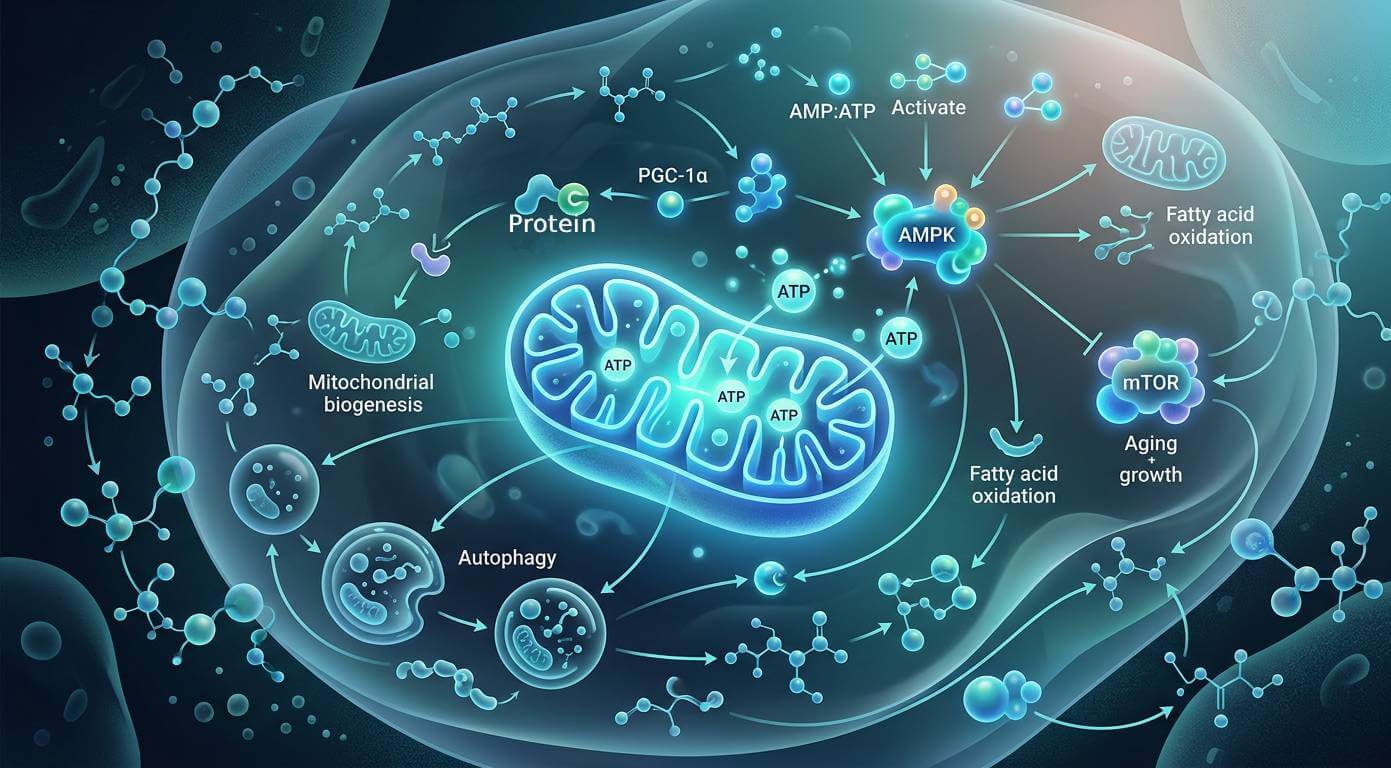
Researchers began digging into the drug’s deeper effects, and what they found was a biochemical footprint that touched nearly every hallmark of aging:
- AMPK activation (the cell’s energy‑stress sensor)
- mTORC1 inhibition (a pathway linked to growth vs. repair)
- reduced chronic inflammation
- improved autophagy and mitophagy
- better mitochondrial efficiency
- lower oxidative stress
- changes in the gut microbiome
Metformin wasn’t just a glucose drug. It was a metabolic signal, one that nudged cells toward repair, resilience, and lower inflammatory tone.
But here’s the twist: The more we learned about metformin, the more we realized how little we understand about human aging in the real world.
2. What Metformin Actually Does: Mechanisms, Not Hype
To understand why metformin became the poster child for longevity research, you need to understand its mechanistic signature.
AMPK: The Master Switch
Metformin activates AMPK, a protein that tells cells:
“Energy is low — shift into maintenance mode.”
This triggers:
- increased fat oxidation
- reduced glucose production
- improved insulin sensitivity
- enhanced cellular cleanup
mTORC1: The Growth Brake
Metformin indirectly inhibits mTORC1, a pathway that promotes growth when nutrients are abundant. Lower mTORC1 activity is associated with:
- longer lifespan in animals
- improved stress resistance
- reduced inflammation
Inflammation and SASP
Metformin reduces inflammatory signaling and dampens the senescence‑associated secretory phenotype (SASP), a major driver of age‑related tissue damage.
Mitochondrial Modulation
Metformin mildly inhibits mitochondrial complex I, a stress that paradoxically improves mitochondrial efficiency over time.
Oxidative Stress
By improving redox balance, metformin reduces oxidative damage to DNA, proteins, and lipids.
These mechanisms are real. They’re measurable. They’re biologically meaningful.
But they’re only part of the story.
Because metformin’s effects vary wildly from person to person… and that variability exposes a deeper problem in how we study human health.
3. The Problem With Human Studies: The Variables We Ignore
Most clinical trials assume humans are interchangeable. They’re not.
Two people in the same study can have completely different:
- diets
- microbiomes
- stress levels
- sleep patterns
- air quality exposure
- physical environments
- metabolic states
- inflammatory baselines
- toxin exposure
- circadian rhythms
And yet, these variables are rarely controlled, or even measured.
Diet
Self‑reported diet logs are notoriously inaccurate. But diet affects:
- inflammation
- insulin response
- microbiome composition
- oxidative stress
- mitochondrial function
A metformin study that doesn’t control diet is already compromised.
Air Quality
Air pollution increases:
- inflammation
- oxidative stress
- cardiovascular risk
- epigenetic aging
Someone living near a highway is biologically different from someone living near a forest… yet both are treated as identical participants.
Stress and Sleep
Chronic stress and poor sleep alter:
- cortisol
- immune function
- metabolic regulation
- inflammation
These variables can overshadow the effect of any drug.
Microbiome Differences
Metformin’s effects are partly mediated through the gut microbiome, which varies dramatically between individuals.
Environment
Noise, light exposure, temperature, humidity, and chemical exposure all influence biology.
Yet most studies ignore them.
This is why metformin sometimes looks like a miracle drug… and sometimes looks like nothing at all.
It’s not the drug that’s inconsistent. It’s the context.
4. Why Two People React Differently to the Same Compound
This is one of the most important — and least discussed — truths in medicine:
The same compound can have completely different effects in different people.
Why?
Because biology is not linear. It’s conditional.
Baseline inflammation matters.
A person with high inflammation may respond strongly to metformin. A person with low inflammation may see no effect.
Metabolic state matters.
Insulin‑resistant vs. insulin‑sensitive individuals respond differently.
Age matters.
Metformin can be beneficial in younger animals but harmful in very old ones.
Microbiome matters.
Metformin’s metabolic effects depend partly on gut bacteria.
Environment matters.
Air quality, stress, and diet can amplify or blunt drug effects.
This variability isn’t noise, it’s the signal. It’s telling us that human health is context‑dependent.
And that brings us to the next question.
5. The Case for Studying Multi‑Compound Stacks
If aging is multi‑factorial, why do we study one compound at a time?
Metformin affects AMPK and inflammation. NMN boosts NAD⁺ and mitochondrial repair. Resveratrol activates sirtuins and AMPK. NAC increases glutathione and reduces oxidative stress.
Individually, each compound touches one part of the aging puzzle. Together, they might form a coherent strategy.
But we don’t know… because almost no one studies combinations.
Why?
- Multi‑compound trials are expensive.
- They’re complex.
- They’re unprofitable (most compounds are generic).
- Regulators prefer single‑variable studies.
Yet real biology doesn’t work one variable at a time.
Aging is a network problem. It requires network solutions.
6. The Redox Paradox: When Antioxidants Help… And When They Hurt
NAC, glutathione boosters, and other antioxidants reduce oxidative stress, which sounds universally good.
But here’s the paradox:
- Too much ROS is harmful.
- Too little ROS is also harmful.
ROS (reactive oxygen species) are not just damaging byproducts, they’re signals that trigger adaptation.
This is why:
- High‑dose antioxidants can blunt exercise benefits.
- Some antioxidants may protect cancer cells from therapy.
- Hormetic stress (like metformin’s mitochondrial effect) can be beneficial.
The lesson?
Context matters. Dose matters. Timing matters.
There is no universal “good” or “bad”… only biological conditions.
7. Why We Need Public Funding for Real Longevity Research
Here’s the uncomfortable truth:
The studies we need most are the ones no company will pay for.
No pharmaceutical company will fund:
- metformin + NMN + NAC + resveratrol trials
- environmental‑controlled aging studies
- diet‑controlled inflammation studies
- air‑quality‑controlled metabolic studies
- multi‑compound synergy research
- long‑term healthspan trials
Why?
Because there’s no patent. No billion‑dollar drug. No shareholder return.
But the public benefit could be enormous.
Imagine:
- affordable interventions
- fewer chronic diseases
- reduced healthcare costs
- longer healthspan
- better quality of life
This is why public funding matters. It’s the only way to study what actually helps people… not what helps balance sheets.
8. What a Real Study Would Look Like
A proper longevity study would control:
- diet
- air quality
- sleep
- stress
- environment
- microbiome
- baseline inflammation
- metabolic state
It would test:
- metformin alone
- NMN alone
- NAC alone
- resveratrol alone
- combinations
It would measure:
- NAD⁺ levels
- AMPK/mTOR activity
- mitochondrial function
- inflammatory markers
- oxidative stress
- cognitive performance
- physical resilience
- healthspan metrics
It would stratify participants by:
- age
- metabolic health
- environment
- diet
- microbiome
This is the study the public deserves. It’s the study that could change everything.
9. The Path Forward
Metformin is not the miracle. It’s the messenger.
It’s telling us:
- aging is modifiable
- inflammation is central
- metabolism matters
- environment matters
- context matters
- combinations matter
- public funding matters
The future of preventive medicine won’t come from a single drug. It will come from understanding the systems that shape human biology, and designing research that reflects the world people actually live in.
This series, The Hidden Variables of Human Health, is dedicated to exploring those systems.
Because if we want real answers, we need real studies. And if we want real studies, we need public demand.
SportsMagazine.ca is stepping into that conversation, not with hype, but with clarity, curiosity, and a commitment to asking the questions that matter.